Childlike Wonder in Art
Art trend in 2026; Childlike Wonder, sincerity over Refinement
The art world has long been dominated by paintings that demand explanation and context. A slight weariness is slowly creeping in among art collectors and art lovers.
And the question arises: where has the direct feeling in paintings gone? Where is the emotional story that doesn't need to be deciphered first?
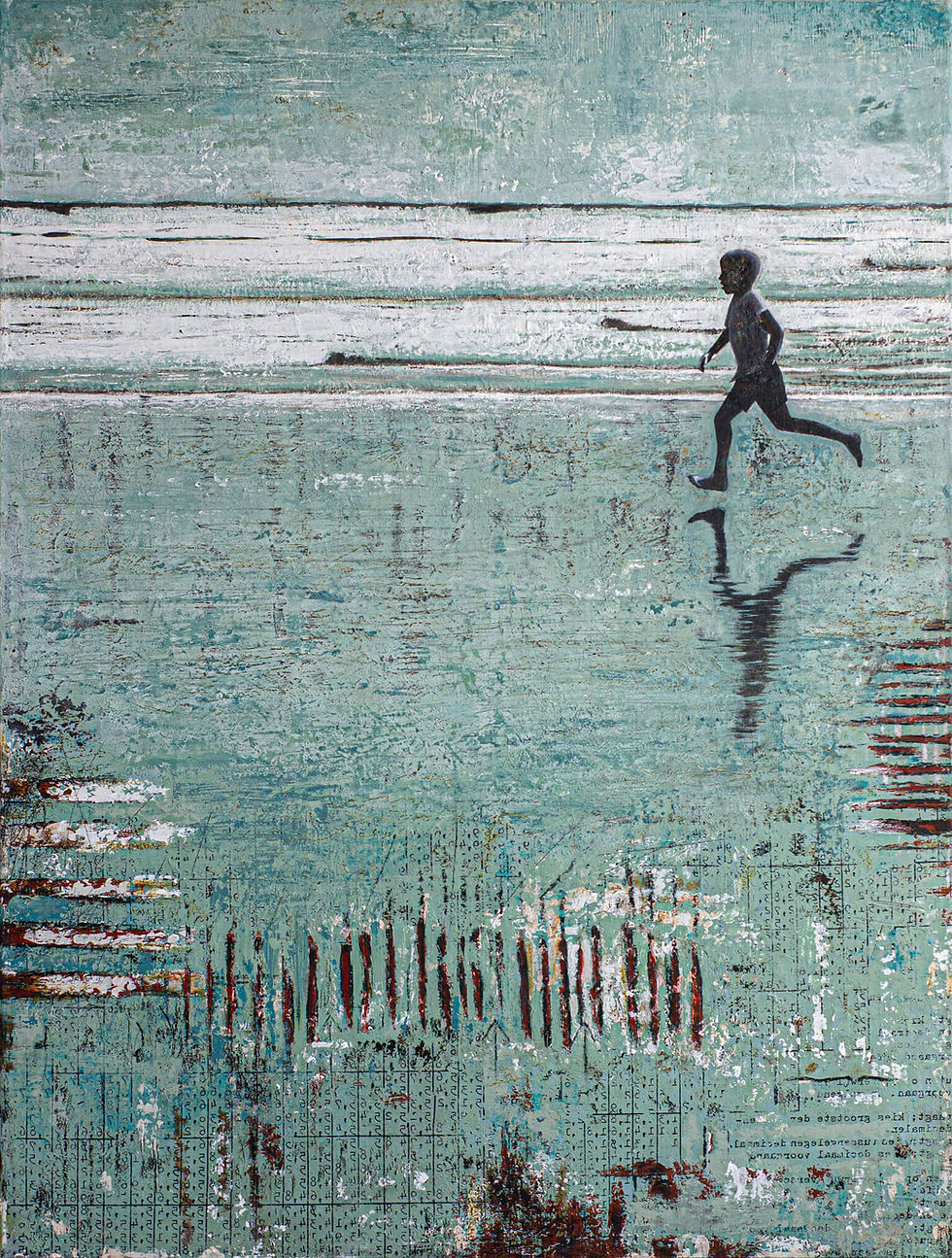
In my mixed media artworks, I have been using images of children for years. For me, they are vehicles of movement, adaptation, and resilience. I don't use them as romantic motifs, but as reflections of our times.
My paintings and mixed media works always return to one core: the child who continues to play, even when the world becomes harsher.
In this blog, you can read why childlike wonder is not an escape from nostalgia, but a powerful artistic statement.
You'll read about the use of black-and-white images reminiscent of old photographs. About children in motion. And the theme of adapting to an increasingly harsh world. and war converge in a visual language that communicates directly. And why this form of art is more relevant now than ever.
Why this movement is becoming visible now
You see it more and more;
Maximalism, kitsch, and nostalgia are appearing in interiors, fashion, and art. That's no coincidence. It says something about what we long for.
We live in a time when everything moves fast. Much art has become increasingly conceptual in recent years. Increasingly complex. You often had to read a text before understanding the work.
People want art that you feel immediately.
Art that isn't ironic.
Art that isn't distant.
Art that moves you without explanation.
That's why it's logical that themes with children in art, childhood, nostalgia, childhood memories, innocence, and the use of black and white as if they were old photos, are highly valued by art lovers.
Not because they want to return to the past. But because it resonates.
Because it's clear and because there's a connection.
People want something real.
Something that resonates immediately.
Something that recalls a time when children playing safely outside was a given. And that's exactly where space for my work arises.

Childlike wonder is not naiveté.
Childlike wonder is often confused with sentimentality. As if it were something soft. Something sweet. Something that only concerns a memory of the past.
But that's a misunderstanding.
For me, the child is not a symbol of vulnerability, but of survival.
Many children must constantly learn to cope with change.
With new places. With new people. With completely new living conditions.
And children always adapt. Without resistance. They have to.
Adapting to moves, loss, war, and to a world that is becoming increasingly harsh and where there seems to be less and less room for children.
And yet they play.
That's what moves me. Not the perfect, cheerful image of the child. But the child who keeps going. Who falls and gets back up. Who keeps moving, even when the environment doesn't feel safe.
That movement is essential to me.
Movement is life. Movement is hope. Movement is resilience.
That's why you rarely see still figures in my work. Children run, jump, play, search for their place. Sometimes small in the frame. Sometimes almost disappearing. But always present.
For me, childlike wonder isn't a naive turning away from reality. It's a way of dealing with it. A way of creating space within something that can be hard.
Why I use children in my artworks
Children are always moving and rarely sit still. They run, stumble, recover and carry on. There is something essential in that natural movement. It is pure life.
When I paint children, they don't have to pose in a beautiful, perfect posture.
Quite the contrary. I want to depict them in their natural movements. That is where the tension and energy arise.
Their movement brings a work of art to life. It tells a story.
Without that movement, a painting quickly becomes a memory, like a photograph.
The movement draws the viewer into the story and makes them ask questions.
As long as there is movement, there is optimism and development. Even when the background is rough and dark or the atmosphere is gloomy, that child remains a sign of hope.
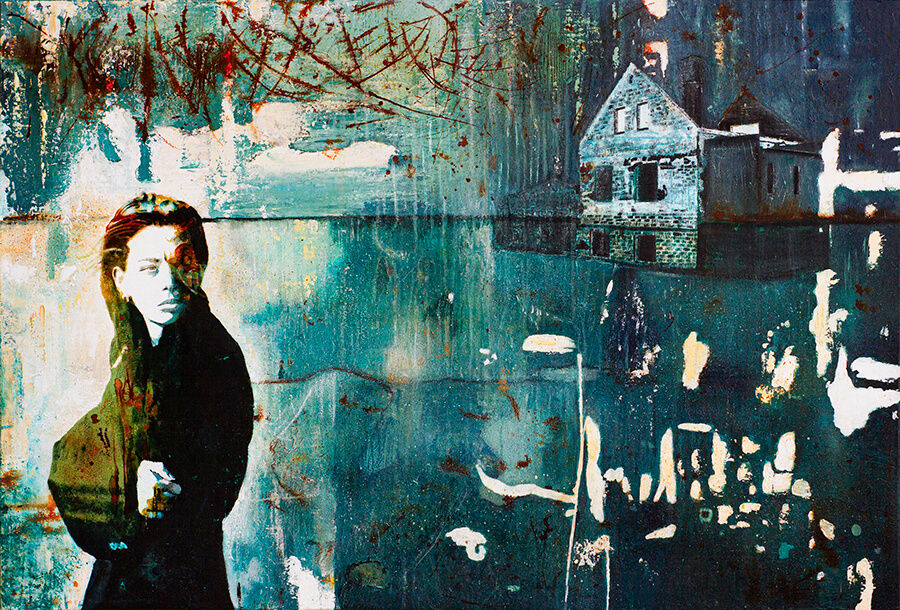
In my artworks, I often use the contrast of a child moving in an environment that is not soft and friendly. That makes the image interesting. I want to show that children can adapt to circumstances that are not perfect.
That is why I use children in my paintings. Because they are the symbol of life that goes on.

Why I paint my children in black and white
1. With the black and white children, I want to refer to old black and white photographs from the past, to make it clear that children used to play outside much more in the past. So with this, I want to emphasise an image from the past.
Black and white in my work is not just an aesthetic choice — it is a layer of memory.
2. Black and white images evoke nostalgia, but they also create a stark contrast with the background. This puts much more emphasis on the child.
You can read more about this topic:
Why this imagery is relevant now
Many children are growing up in a world that has changed dramatically, especially when compared to the world in which children grew up years ago. Back then, playing outside was normal and there were no digital screens.
For children today, there is a constant stream of information, climate threats, digital stimuli and a lot of social pressure.
Children have to deal with this and adapt faster than ever before.
That is why the black and white image of a child playing reminds us of:
Our own childhood
Innocence that is not naive
Childhood fears that are universal
Childhood memories that shape us

Questions from Art Buyers
Is this artwork nostalgic or contemporary?
For me, it's both. Artworks about children, childhood, and nostalgia often immediately evoke associations.
When art lovers or galleries see my work, questions often arise. That's understandable.
The use of black-and-white images, the reference to old photos, evokes memories of the past.
But the theme is contemporary. Children adapting to an increasingly harsh world, continuing to play despite uncertainty—that's more relevant than ever.
That's why the background of my paintings is contemporary, sometimes modern, and in color.
Is this art figurative or symbolic?
In images, it's clearly figurative. You see children, bodies, movement. But it's also symbolic. The child I paint isn't just a child, but a symbol of movement, adaptation, and resilience.
Yet, the symbolism doesn't always need to be explained to understand what I mean to say with my work.
The child in a specific environment
Ultimately, my paintings are not just about the child, but also about their environment.
That environment changes. Sometimes it's abstract, composed of layers of paint, scratches, stains, and textures.
Sometimes it resembles a street art background, with rough, weathered surfaces. And sometimes it's an open landscape, a field of flowers, a beach, with space and a horizon.
My choice is never coincidental.
The abstract backgrounds give me space. They make a landscape interpretable.
The street art-like surfaces bring roughness. They refer to a harsher, more urban world. A world where there seems to be little room for a child, where they must try to survive.
And then there are moments when the landscape is more open. A field. A horizon. A more recognizable space. There, breath arises. But also fear. Of the unknown.
Whatever the landscape, abstract, urban, or natural, it always revolves around the same thing: how does a child move in this environment?

Finally:
Childlike wonder in artwork is a way to counterbalance an increasingly harsh and complex world. Not just for children!
Children in art show us adaptation, movement, and the ability to survive. It's not an aesthetic trend.
In a time when art is often purely decorative or conceptually distant, and often even digitally created, the need for genuine emotion is growing. This work reminds us of childhood, innocence, but also strength.
As an artist, I have been exploring this theme for years. In my mixed media paintings, I have used the image of the moving child for years.
And many artworks featuring children have found their way into living rooms and offices.
Are you considering purchasing a piece of art?
Are you curious about my work, my working methods, or the possibilities of direct purchase?
You are always welcome to:
view my current collection
discover the story behind a piece of art
contact me with questions
or schedule a studio visit
Together, we can discuss what suits your interior, without pressure or obligation.
You buy art with care.
That care begins with a conversation.
Visit my Studio!
You are always welcome to visit my studio gallery at
Strijp-S in Eindhoven, The Netherlands
Or take a look at my online portfolio.
Please contact me with any questions or requests you may have!
Please contact me if you have any questions. I can help you choose or create a piece of art that fits your interior!