Why I use black and white figures in my artwork
And how that contributes to art with a story
For years, as a mixed media artist, I have been creating melancholic landscapes, rough and weathered textures, and urban art with a touch of street art.
But there is one element that people notice first when they see my work: the black and white painted figures.
For me, that visual contrast is much more than a stylistic element. It is a conscious choice, deeply connected to memories, imagination and the way I want my stories to speak.
In this blog, I will take you through the origins of this choice, why the black and white painted figures have become so characteristic of my style, and how they contribute to original art for above the sofa, in the living room or in the office — art that not only fills your space, but also adds depth to it.

1. My black and white figures were old photographs at first
My fascination with black and white images began as a practical choice.
When I started making art again twelve years ago, I didn't have the budget for fancy materials. I worked with whatever I could find: leftover paint, torn-up magazines, old newspapers, and especially old photos from books and old magazines that I found at flea markets.
These yellowed images of unknown people and children who no longer exist, moments long gone, formed the basis of my early collage works. I cut them out, placed them in new contexts, and soon noticed that it was precisely that black and white, that timelessness, that quiet melancholy that did something to the composition. It gave my landscapes a soul. The contrast made the figures stand out even more.
What was intended as a purely aesthetic choice grew into an important part of my visual language. Art with a story was born, a story in which the past mingles with the here and now.
2. When I started painting the figures myself, they remained black and white.
The people remained black and white figures when I started painting them myself.
At a certain point, I dared to take the step of painting my figures myself.
That felt fairer and more real, more personal and more connected to the rest of my work. But the people remained mainly black and white figures.
Because I noticed that it was precisely that element that carried the emotional charge I was looking for. A person in colour felt too much like “here and now”. Too concrete, too modern. And I felt that a figure disappeared too much into the environment.
Black and white, on the other hand:
suggests memory
blurs time and place
adds a calm silence to the work
makes the figure more universal, fillable for everyone
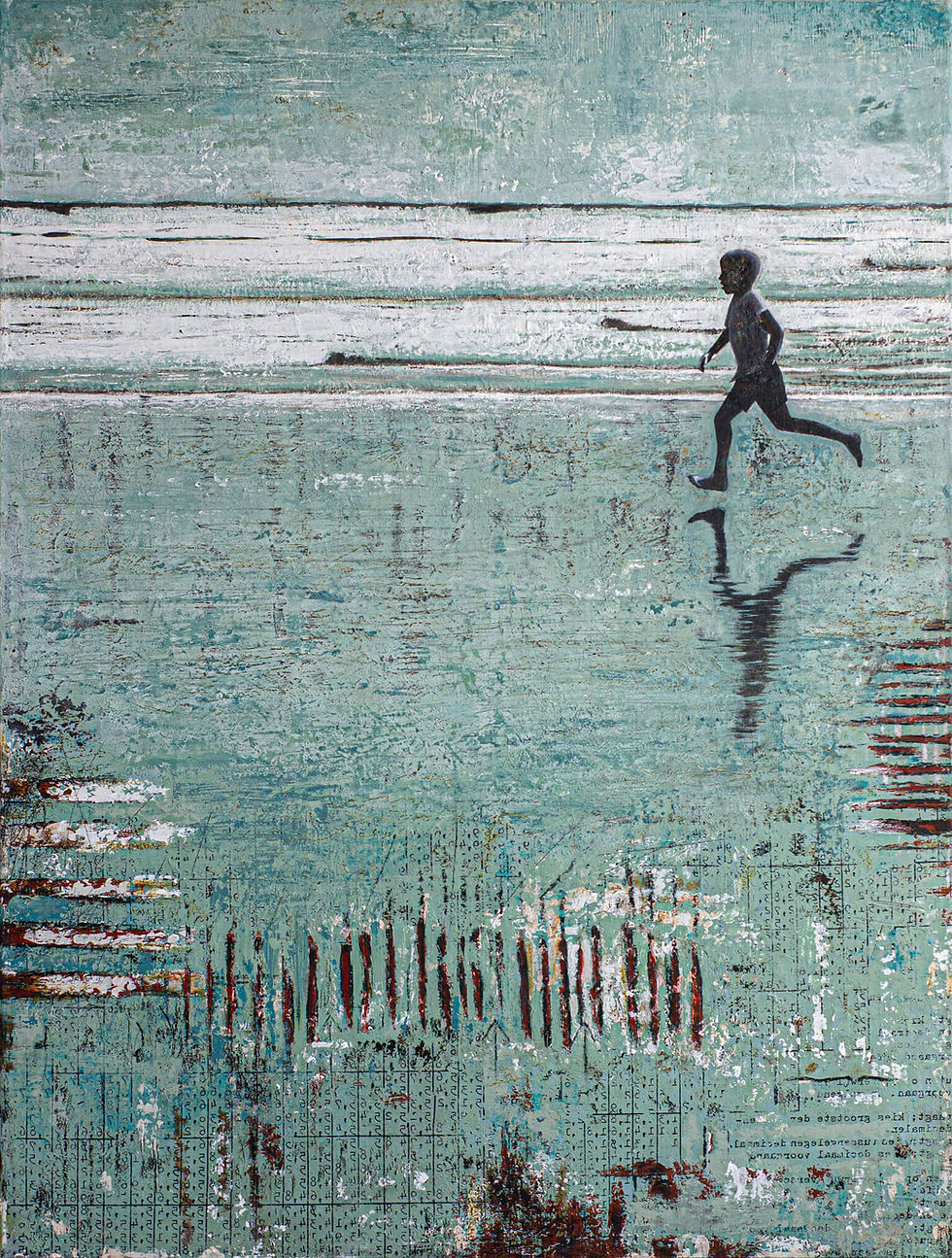
My black-and-white figures literally became carriers of memories. Not only mine, but also those of the viewer. People often told me that they recognised their own past in my work: their own child on the beach, themselves on holiday in the past, something they had experienced themselves but could no longer place exactly.
That's what I like best; the monochrome people leave room for interpretation,
for projection. They create the story in my paintings, which is filled in by the viewer themselves.

3. Black and white figures as a point of contrast
Many of my artworks have a slight melancholy.
Sometimes sombre, but always gentle and reflective. It is as if you are looking at a memory that seemed to have been forgotten. My use of colour is often soft, muted, faded by the way I work with my materials; I create layers with collage and image transfers mixed with acrylic paint.
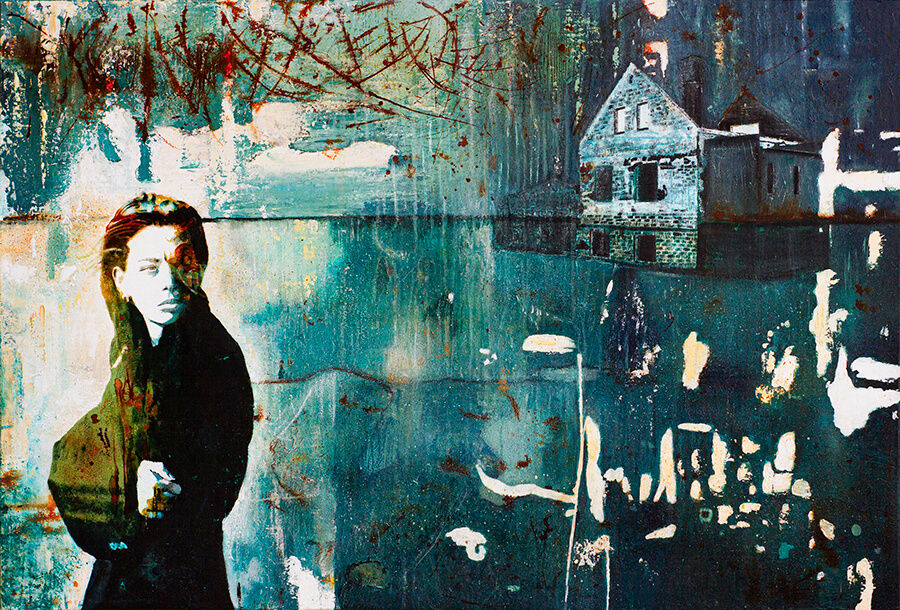
It is precisely on these calm and weathered layers, where sometimes a great deal of detail can be seen, that a black and white figure acts as a sharp, contrasting element. It creates:
A point of calm
Focus in a layered composition
A powerful visual hierarchy
An almost photographic moment in a painted environment
It is similar to the effect of street art-like art on rough walls: something normal, simple or human stands out against a weathered background.
In my work, it is almost always that one person, playing, walking, waiting, searching, who immediately catches the eye. And that is precisely what makes my art suitable for places where you want both atmosphere and story: art for the living room, a workplace or office where you want to dream away from time to time.
4. Black-and-white figures make a painting more personal for the viewer.
Many people think that colour adds emotion, and that is usually true. But in my work, I notice that it is precisely the absence of colour in the figures that opens up a deep emotional space. If colour determines a clear direction, black and white offers possibilities.
A black-and-white figure can:
represent a memory
evoke a sense of nostalgia
show a universal human moment
invite the viewer to look further
It seems as if the figure is detached from time. Not bound by fashion, trends or specific situations. This allows viewers to recognise themselves, a child, a parent, a friend, a passer-by; someone who also appears in their story.
This is one of the reasons why my works fit well in many interiors.
Often chosen as original art for above the sofa or in an office space: they not only blend into an interior, but also add a story to it. A topic of conversation.

5. How black and white figures define my own style
My technique is always evolving. My themes and subjects will also always vary. But the black and white painted people are the most constant elements in my work.
Here and there, the people are placed under a transparent layer of colour, but the basis will be monochrome.
Not by accident. Not out of habit. But because it tells exactly what I want to say:
That memories are fleeting.
That melancholic landscapes sometimes say more than words.
That contrast can give meaning.
That art can serve as an anchor point in a space.
And that a person, no matter how small they are depicted, is always the centre of the story.
For me, black and white has become a way to pause time for a moment. To capture a moment that lingers, amidst colour, structure and layered chaos.
And perhaps that is precisely why many people recognise my art. The monochrome figures define my distinct style.
In conclusion
My choice of black-and-white figures is not an aesthetic trick, but an essential part of my visual language. It refers to my early years with collage and old photographs, but it also symbolises what I am trying to convey: stories that are not bound by colour or time, but by emotion.
Whether it's art for the living room, a melancholic landscape for the office, or street art-style art as an original eye-catcher above the sofa — the black-and-white figures always remind you that there is a story behind every image. And as the viewer, you can finish that story yourself.
Visit my Studio!
You are always welcome to visit my studio gallery at
Strijp-S in Eindhoven, The Netherlands
Or take a look at my online portfolio.
Please contact me with any questions or requests you may have!
Please contact me if you have any questions. I can help you choose or create a piece of art that fits your interior!